

Culture & Belonging · Original fiction
Far from home, a daughter discovers that a family recipe carries more than ingredients.
The missing measurement
In her small apartment overseas, Tara tried to make the dish her grandmother prepared every festival. The recipe on her phone said one cup of lentils and a little tamarind. A little, she discovered, was not a measurement that survived a long distance. She called home with a pot already simmering and a rising sense of defeat.
Tara had bought the ingredients from three shops. One stocked the lentils under a name she had not seen before; another sold tamarind in a package her grandmother would have considered unnecessarily elaborate. She arranged everything on the counter and sent a photograph home. The replies arrived immediately: a correction about the spice, a question about the pan, an unrelated warning that the weather looked cold where she lived. She felt irritated by the advice and comforted by its familiarity. Then she began cooking. In her grandmother’s kitchen, the dish had seemed to emerge from movement rather than measurement. A hand reached into a jar, a lid was lifted, something was tasted and adjusted. Alone, Tara found herself missing the instructions nobody had thought to speak aloud. The recipe existed inside a sequence of habits. She had brought the ingredients across the distance without bringing the person who knew when each habit belonged.

Instructions that sounded like home
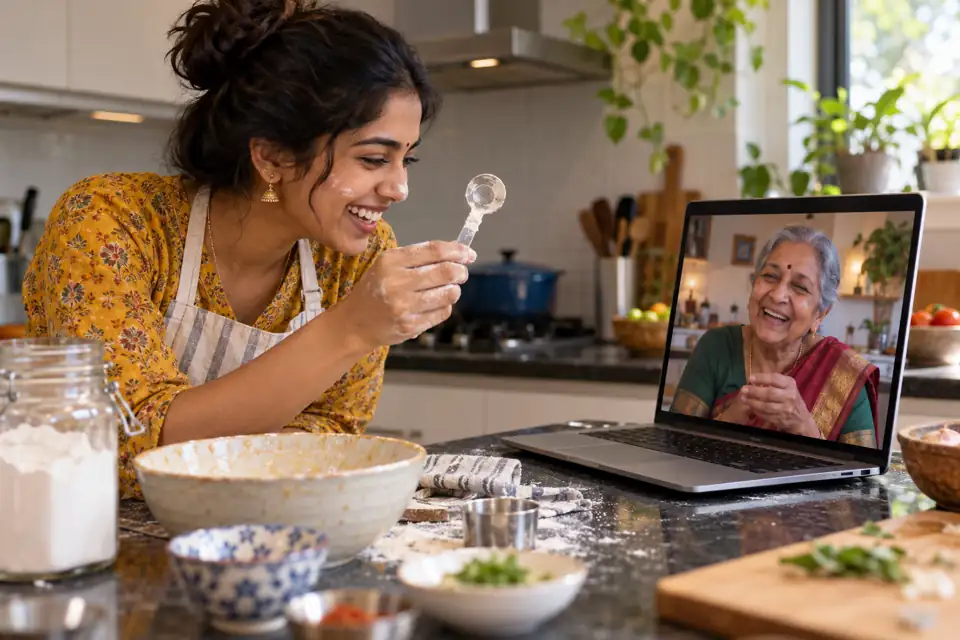
Her grandmother asked about the smell before asking about the quantity. Tara laughed in frustration. How could she send a smell through a phone? Her grandmother laughed too. Together, they worked it out using the spoon Tara held up to the camera. The first attempt was still too sour. They ate dinner at different times, on different continents, and remained on the call.
Her grandmother asked Tara to move the phone away from the steam so she could see the pot. For several minutes, the conversation consisted of practical instructions and the cheerful commentary of relatives passing behind the camera at home. Tara wanted quiet expertise and received a household. Someone disagreed about the quantity of spice. Someone else asked whether she had eaten breakfast. She nearly lost patience again, then noticed her grandmother waiting for the interruptions to finish with the same expression she remembered from childhood. The video call had not transported a perfect version of home into the apartment. It had brought its inconvenience too. When they finally agreed on the spoonful of tamarind, Tara repeated the measurement aloud and wrote it on the back of an envelope. Her grandmother warned that the ingredient might be stronger than the one she used. Tara underlined the word taste. It was an instruction she would have to learn through experience rather than translation.
More than a recipe
The next weekend, Tara asked again, this time before lighting the stove. She wrote the instructions in English and kept her grandmother’s words beside them in Tamil. Some phrases would not sit neatly in translation. She recorded an explanation rather than replacing them. The recipe included a story about a neighbour lending a pot, a festival during heavy rain and the person who always wanted an extra serving.
At the second attempt, Tara asked why the dish appeared at that festival in their family. Her grandmother said it had not always been the centre of the meal. A neighbour made it one year when another preparation went wrong, and everyone requested it again. Tara had expected an ancient explanation and received a recent accident. She liked the story more for being specific. It reminded her that tradition could contain improvisation without becoming less meaningful. In the notebook, she distinguished what she knew from what she was still asking about. She recorded family versions rather than presenting them as the habits of everyone who shared their language or background. Her grandmother helped spell a phrase, then corrected her own explanation of it the following week. The page became crowded with arrows. Tara decided not to rewrite it neatly yet. The corrections showed a conversation still taking place, not a finished object she needed to place behind glass.

A table with room
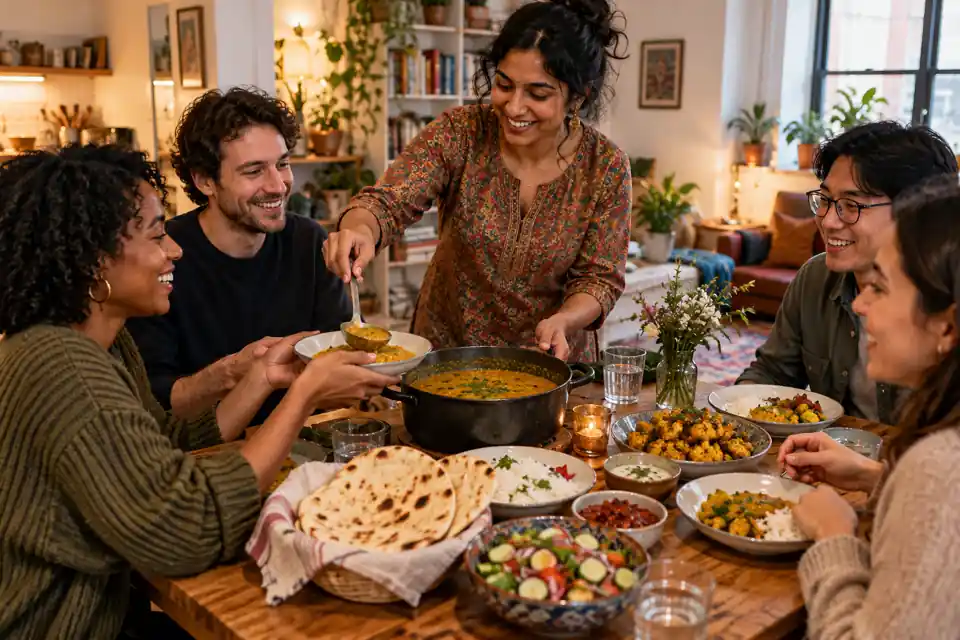
When friends came to dinner, Tara told them the dish was her version, made with what she could find locally. One friend brought bread. Another brought a recipe from his own childhood. Nobody pretended the table reproduced home perfectly. It held several homes at once. Tara sent her grandmother a photograph of the empty serving bowl.
Before her friends arrived, she worried about whether the meal would seem disappointing after the story she had told about it. The rice was slightly late, and one bowl did not match the others. Nobody minded. Her friend Samir recognised a spice from his own childhood but used it in a different dish. Another guest described a family disagreement about what counted as the proper version of a soup. The conversation travelled comfortably between affection and complaint. Tara realised that belonging did not require everyone at the table to share the same memory. It could grow through the attention they gave to one another’s memories. She explained which parts of the meal she had adapted and why. The substitutions stopped feeling like evidence of failure. They were a record of where she lived now. When her grandmother replied to the photograph, she asked whether Tara had saved some for the next day.
What belonged to her
She kept revising the notebook: clearer measurements, local substitutions and the stories that arrived during each call. The two languages shared the page without one becoming a footnote to the other. She had wanted to preserve a flavour. Instead, she found a way to keep asking questions. The recipe became a place where distance could be acknowledged without having the final word.
The following month, a relative asked Tara to send the recipe. She sent a photograph of the untidy pages and added a note explaining the local ingredients she had used. Then she called her grandmother to ask whether the neighbour in the festival story was still living nearby. They talked about several people Tara remembered only as the adults who moved through childhood celebrations carrying hot vessels. Each person acquired a name, a particular laugh or a small habit. The recipe had opened a history that would not have emerged from asking for important family events. On the final page, Tara wrote an invitation to whoever cooked from the notebook next: add your changes and the place where you made them. She did not want a perfect replica to be the price of participation. She wanted the dish to keep gathering evidence of people making room for home in the lives they actually had.

An original fictional story created for eautobiography Journal. Characters and events are imagined.