
Purpose & Personal Growth · Original fiction
After retirement, a teacher discovers that purpose can fit inside one small room.
A quiet first Monday
For thirty-two years, Anitha had known what Monday required. There were lessons to prepare, forms to sign and children asking questions before she reached the classroom. After retirement, she washed the breakfast cups slowly and checked a phone that had nothing urgent to tell her. Everyone said she deserved a rest. She agreed, but rest did not answer what she was for.
She had prepared for retirement in practical ways. The pension paperwork was complete. A cupboard had been cleared of old lesson plans. She had promised to visit a cousin and finish several books. None of that prepared her for the first morning when nobody needed a decision from her before nine. At school, she had complained about interruptions. At home, she discovered how much of her identity had been held together by them. Her daughter advised her to enjoy the freedom. Anitha did enjoy parts of it: a slow breakfast, a bus taken outside rush hour, the luxury of finishing a cup of tea while it was hot. What unsettled her was not spare time itself. It was the suspicion that she had become useful only in the past tense. The notice at the community centre offered something concrete enough to interrupt that thought.

A room behind the hall
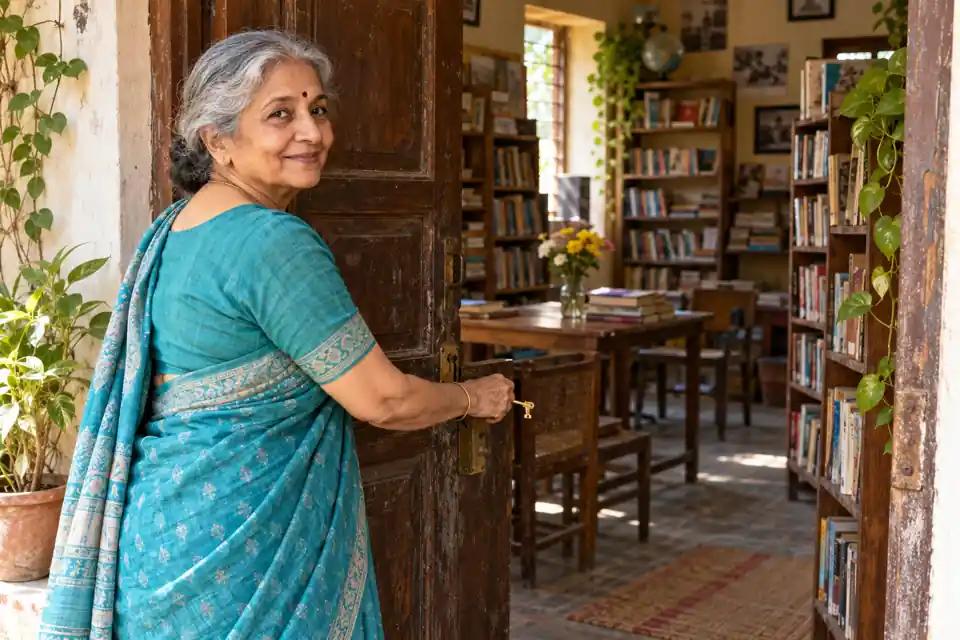
At the community centre, a notice asked for someone to open a cupboard of donated books twice a week. Anitha imagined a proper library and found a small room with uneven shelves. Half the books needed cleaning. The chair creaked. She nearly handed the key back. Then a child appeared carrying a comic with its cover missing and asked whether this place was open.
The cupboard contained several copies of the same school dictionary, a novel missing its final pages and a book of birds with a child’s name written inside. Anitha made three piles, then stopped when she realised she had recreated a staff-room task. Nobody had appointed her to turn the room into an institution. A caretaker arrived with a kettle and told her the light switch sometimes needed pressing twice. He had been opening the room whenever someone asked, but could not stay there through the afternoon. Anitha asked what readers wanted. He shrugged. Somewhere to sit, perhaps. The answer sounded too modest until the child with the damaged comic appeared. He did not ask whether there was a catalogue. He wanted to know whether he could finish the story before going home. She moved the cleaning cloth from the chair and invited him to sit.

Something smaller than a classroom
On the first afternoon, three children came. On the second, only one. Anitha caught herself measuring the room against the full school she had left. She was about to plan a complicated reading competition when the child asked her to help write a letter to his grandmother. They spent twenty minutes deciding how to describe a new puppy. The letter contained no impressive vocabulary. It sounded exactly like him.
The letter-writing child was called Manoj. He knew how to address an envelope but worried that his grandmother would find his handwriting difficult. Anitha offered a fresh sheet. He declined because he had already drawn the puppy in the corner. That decision stopped her from correcting the page too aggressively. They discussed what the animal actually did rather than searching for words that sounded clever. The puppy chewed a slipper, slept under a chair and became frightened of its own reflection. Manoj laughed while explaining the reflection. Anitha wrote the unfamiliar word on a scrap of paper and let him copy it at his own pace. When he left, she looked at the chair opposite hers. For years, she had measured a useful afternoon through the number of things completed. This one had produced a single letter. She could still hear the child’s laughter, which did not fit anywhere in her old measures.

A use for the quiet
Gradually, the room found its rhythm. A shopkeeper borrowed a history book. Two siblings argued over a story and returned to explain their truce. Anitha began placing a notebook near the door for readers to recommend books to each other. She did not need to direct every conversation. Sometimes her most useful act was making sure the light was on.
Not everyone who entered wanted her assistance. A teenager preferred to read with headphones on. A man returned a book and left before she could ask whether he liked it. Anitha learned to stop treating silence as an unfinished conversation she ought to improve. She placed a jug of water near the window and marked the shelves clearly. When readers asked for books she did not have, she wrote down the requests without promising what she could not arrange. The recommendation notebook began with her careful heading and several blank pages. Eventually, someone wrote that a particular mystery was worth reading but the ending was unfair. Another person disagreed underneath. Anitha left both comments. She liked arriving to find evidence that the room had a life beyond her supervision. Purpose, she was discovering, could involve maintaining the conditions for other people to do something she did not need to direct.

The key stayed
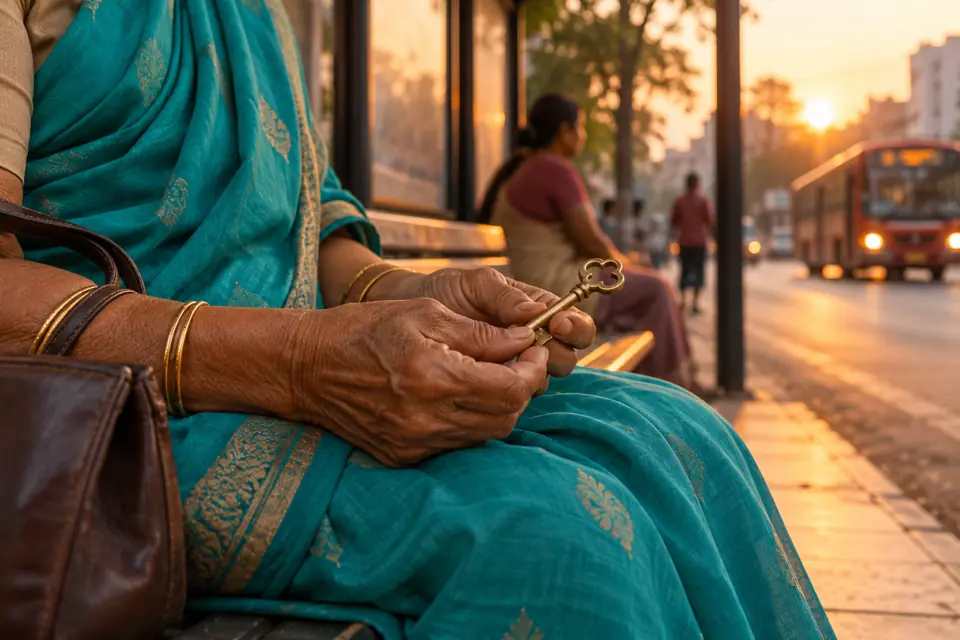
One evening, she felt the library key in her pocket while waiting for a bus. It was smaller than the ring of school keys she had once carried. Her days were smaller too, and she had stopped treating that as a disappointment. A room could be small and still make space in someone’s life. On Monday, she knew where she wanted to go.
One afternoon, rain kept nearly everyone away. Anitha considered closing early, then took a book from the pile she had not yet examined. Inside the cover, a previous owner had written a sentence about reading it on a train. She wondered where that traveller was now and whether the journey remained important to them. At school, she had often asked children to imagine futures. In the library, she found herself becoming curious about unfinished presents: a reader finding a chair, a grandmother receiving a letter, a person spending an hour somewhere that asked very little in return. She began a notebook of her own, recording the room without identifying the people who preferred privacy. On the first page, she described the stubborn light switch. On the second, the damaged comic. Her retirement had not erased her earlier life. It had given her a quieter place from which to keep participating in the one still taking shape.
An original fictional story created for eautobiography Journal. Characters and events are imagined.