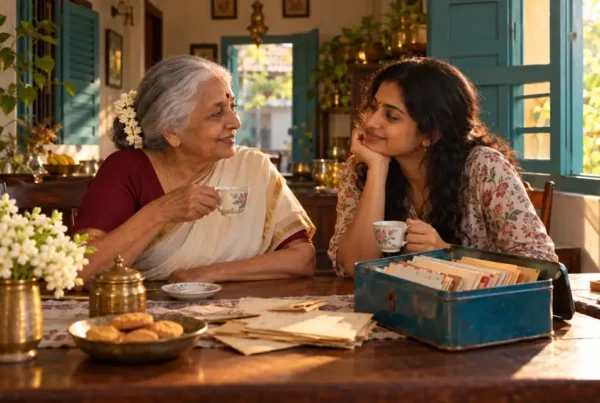

A box of papers can look like a life reduced to dates: school certificates, a first work badge, a folded travel ticket, a photograph from a family celebration. But each item is an opening. The certificate may recall who encouraged you to keep studying; the badge may bring back a difficult first week; the ticket may mark the day you left one home and began another. Personal history writing helps connect records and memories so they read as a human story, not a stack of documents.
A personal history is a record of experiences, relationships, choices and changes across a life. It can be written for yourself, your family, or future generations. It may become an autobiography, memoir, family history, or a private archive. You do not need to record every event. The work is to choose what matters, add context, and preserve the meaning in your own words.
Decide what you want your personal history to do
Start with a purpose. Are you trying to understand your own journey, help relatives learn about a family member, preserve a move between places, or leave a record of work and service? Write one sentence about the reader and the reason for the project. That sentence will help you choose which memories belong in the first version.
Your personal history can be private. It does not have to be published, polished, or shared with everyone. You can keep some chapters for yourself, share selected sections with relatives, or create a book for a small group. Thinking about audience early can make choices about detail and privacy easier.
Build a life timeline as a map, not a checklist
Draw a simple timeline with broad phases: early home, school, work, relationships, changes, and the present. Add places, people, jobs, moves, celebrations, losses, and moments when your direction changed. Use approximate dates when you are unsure. A timeline is a map to help you notice connections; it is not a test of perfect recall.
Then circle the events that still feel vivid or important. Some may be major milestones; others may be small scenes that reveal a value or relationship. A meal shared after a long day, a first attempt at something difficult, or a conversation on a bus may explain more about a person than a list of awards. You can return to the timeline later as more memories surface.
If memories come in fragments, capture them as notes or voice recordings first. Do not force them into chronological order immediately. A detail such as the color of a room, the sound of a machine, or a phrase someone repeated can help you find the larger story when you are ready to write.
Choose a few scenes that carry meaning
For each important period, choose one or two scenes that show what life felt like. Ask yourself: Where was I? Who was there? What did I hope would happen? What changed? What do I understand now that I did not understand then? These questions turn a personal history into a story with movement and reflection.
Try not to summarize an entire decade in one paragraph. Select a representative moment, then provide only the context a reader needs. If you are writing about a career, for example, describe a decision or challenge that reveals what the work meant to you. If you are writing about family, show a tradition in action and explain how it changed across generations.
Meaning does not require a dramatic ending. Some stories end with a question, a continuing relationship, or a lesson that took years to recognize. Let the truth of the experience guide the structure rather than trying to make every chapter inspirational.
Use records to support, not replace, memory
Photographs, letters, diaries, certificates, calendars and objects can help you check dates and prompt recollections. Keep a note of where each item came from and what it can confirm. If you are not certain about a year, write “around” or leave a note to verify later. A small uncertainty is better than a confident detail that may be wrong.
Documents provide evidence of some things, but they rarely explain what a person felt or why a choice mattered. Ask relatives for their memories, and record their perspective with permission. Two people may describe the same event differently. You can include both accounts or explain that recollections vary, rather than forcing one version to stand for everyone.
When using private letters, photographs of other people, or sensitive details, consider consent and privacy. A personal history can honor your experience while treating others fairly. If the project will be shared publicly, review the material for details that reveal information someone did not agree to share.
Find a structure that feels natural
A chronological structure works well when readers need to follow a journey from childhood to the present. A thematic structure can be better when a few subjects connect different years, such as learning, care, work, faith, belonging or starting over. You can also combine the two: organize the book by life period, then use a theme to give each section a focus.
Write a working outline with short chapter names and one sentence about what each chapter will reveal. Move sections around until the sequence makes sense. A strong opening may begin with a defining scene, then return to earlier years for context. The ending can reflect on what continues, what changed, and what you hope the reader carries forward.
Read the outline aloud. If two chapters make the same point, combine or distinguish them. If a long stretch of life is missing, decide whether it matters to the purpose. A thoughtful autobiography is not an inventory; it is a selected account that gives a reader enough detail to understand your path.
Write in a voice that sounds like you
Draft the way you speak, then revise for clarity. Keep expressions and words that feel natural. You can use short paragraphs, questions, or a brief reflection after a scene. If writing is difficult, dictate a memory, make a transcript, or ask someone to help organize your notes. The important thing is that editing does not erase your perspective.
It is fine to leave a pause in the story. Some experiences are complicated or private. You can write only what you are ready to share, save a chapter for later, or mark a section as personal. An honest account can acknowledge what you do not remember and what you are still trying to understand.
If you need a first step, set a timer for fifteen minutes and write about one object from your past. Describe where it came from, who used it, and what it brings back. One scene can lead to the next without requiring you to write a complete life story in one sitting.
Preserve and share the work on your terms
Save drafts, recordings and scans in more than one secure place. Use file names that include a date or topic, and keep original photographs and documents safe. If you create a digital autobiography, think about who can access it, how family members will find it, and whether the format can be updated later.
Some people prefer a printed memoir; others want a digital life story they can share with relatives in different locations. You can also keep a private archive and share only a short selection. The format should support the purpose, the reader and your comfort—not pressure you into a level of public exposure you do not want.
eAutobiography offers tools for organizing and writing life stories. Explore writing your life story online, learn about the digital autobiography platform, or browse its available storytelling features. If your work includes shared family memories, visit family history preservation.
Begin with one page, not the whole life
Personal history writing becomes easier when the first task is small. Choose a purpose, sketch a timeline, and write one scene that still matters to you. Add a record or another person’s memory only when it helps the story. You can revise the structure as the project grows.
Your experiences do not need to be famous to deserve a record. The way you adapted, cared, learned, worked, or made a home may matter deeply to someone who comes after you. Start with a single moment and let the meaning emerge. A life story grows one remembered detail at a time.
If you are ready to begin, start an eAutobiography account and save the memories you want to keep. Your personal history can be a quiet gift to yourself today and to your family in the future.